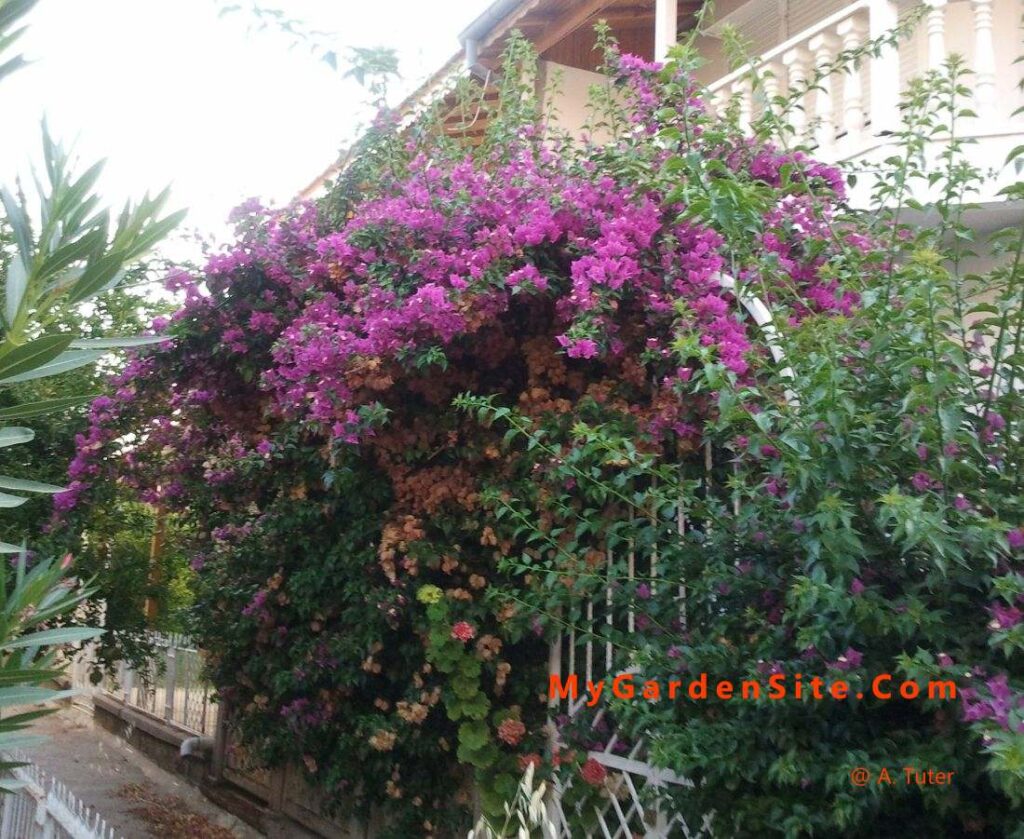
Bougainvillea glabra is a vigorous, woody flowering vine native to South America and a staple of warm-climate landscapes worldwide. It is perhaps the most iconic ornamental plant in Mediterranean-style gardens. The striking purple, pink, red, orange, or white flowers are actually papery bracts (modified leaves). The true flowers are tiny, white, and nestled in the center of these colorful structures. Bougainvillea is the go-to choice for draping walls, pergolas, fences, and facades in dramatic, season-long color.
Plant Shape, Color, Description
Bougainvillea develops sturdy, woody stems armed with sharp thorns and adorned with glossy, oval green leaves. It is a rapid grower, capable of reaching 5 to 10 meters in height if provided with adequate support. Its versatility is a key asset: depending on how it is trained, it can serve as a climbing vine, a dense shrub, a privacy hedge, or even a manicured ornamental tree (standard). The bracts offer a vivid palette of magenta, scarlet, apricot, and snow-white, creating an unmatched visual impact.
Plant Type
Bougainvillea is a woody perennial vine that functions as a climbing shrub. It is long-lived in frost-free climates and adapts well to large containers, provided the soil allows for excellent drainage.
Why You Grow It
Gardeners prize Bougainvillea for its intense, saturated color and exceptionally long blooming season. Once established, it is remarkably drought-tolerant and requires far less “babying” than other tropical ornamentals. Its ability to quickly mask unsightly structures or provide privacy makes it as functional as it is beautiful.
How It Grows / Behavior in the Year
Growth kicks into gear in early spring as the soil warms. Flowering is most prolific during the hot, sunny months, often arriving in successive “flushes” throughout the year. While growth slows in cooler weather, the plant has a unique quirk: mild water stress can actually trigger a heavier bloom, as the plant responds to dry spells by producing more colorful bracts.
Flowers
The “blooms” people admire are technically bracts. The true flowers are small, tubular, and cream-colored, sitting quietly at the center of the display. Flowering is fueled by high heat and intense sunlight; in the right conditions, the plant can remain in bloom for the majority of the year.
Sun
To thrive, Bougainvillea demands full sun. A minimum of six hours of direct sunlight daily is non-negotiable for a good show of color. In partial shade, the plant becomes “leggy,” producing lush green foliage but very few flowers.
Watering
Watering should be deep but infrequent. It is vital to let the soil dry out significantly between sessions. Overwatering is the most common mistake made with this species, often leading to “root rot” and a total lack of blooms. Excellent drainage is mandatory, especially in garden beds with heavy clay.
Plant Care
In early spring, a balanced fertilizer supports new growth. Once the blooming season begins, switching to a high-potassium fertilizer (often labeled as “Hibiscus” or “Bougainvillea” food) encourages more bracts. Avoid high-nitrogen fertilizers, which result in all leaves and no color.
Pruning is most effective immediately after a flowering cycle; trimming back long shoots encourages new wood, which is where the next round of flowers will form. Watch for common pests like aphids or spider mites, which can be treated with neem oil or insecticidal soap.
Winter Behavior
In tropical zones, Bougainvillea remains evergreen. In marginal zones that experience light freezes, it may drop its leaves (deciduous behavior) to survive the cold. It is frost-sensitive and can suffer permanent damage if temperatures dip below -2°C (28°F). In cold climates, it must be moved indoors or heavily protected.
Common Problems
- No Flowers: Usually caused by too much shade, too much water, or too much nitrogen fertilizer.
- Yellow Leaves: Typically a sign of overwatering or poor soil drainage.
- Thin/Leggy Growth: Indicates the plant is reaching for more sunlight.
- Frost Damage: Leaves and soft stems will turn black or mushy after a freeze.
Worth Growing?
Absolutely. For anyone in a sunny climate, Bougainvillea offers an unbeatable combination of drought tolerance, rapid growth, and stop-in-your-tracks color. It is one of the most rewarding and low-maintenance investments for a high-impact garden.
Plant Profile
Botanical Name: Bougainvillea glabra
Plant Type: Woody perennial vine / climbing shrub
Family: Nyctaginaceae
Origin: South America
Lifespan: Perennial
Mature Size: 5–10 m (with support)
Other Names:
EN: Bougainvillea · DE: Drillingsblume · ES: Buganvilla · RU: Бугенвиллия · TR: Begonvil (Bugenvil)
.
Post By: A. Tuter
————————————-
Terms of Use: Unauthorized copying is prohibited; we maintain dated records to document original publication. Content is provided “as is” and may contain inaccuracies. See our Terms Page.